
How Real Estate Agents Get Paid for Vendor Referrals
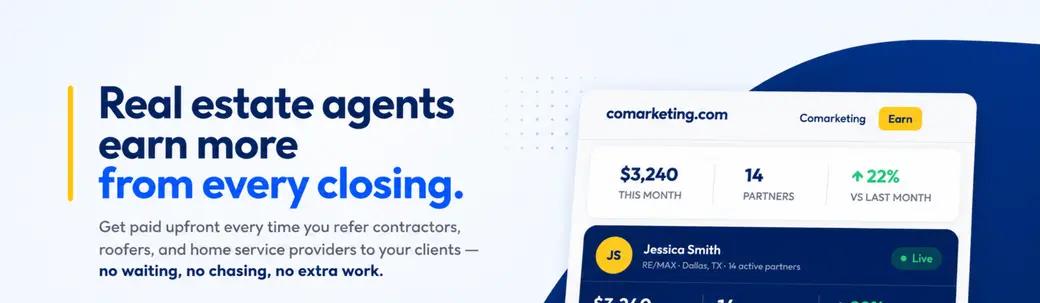
How Real Estate Agents Get Paid for Vendor Referrals (Instead of Doing It for Free)
Every closing comes with a follow up text. Your buyer needs a roofer after the inspection. Your seller needs a mover. Your past client's AC dies in July and you're the first person they call, not because you're a contractor, but because you always know a guy.
You've built that trust for free, for years. There's a growing group of agents who stopped doing it for free.
Why This Is a Real Income Stream, Not a Gimmick
Referral income already exists inside real estate. Agents refer clients to other agents in different markets and collect a percentage of the commission when the deal closes. Nobody blinks at that model.
Vendor referrals work the same way, just outside the transaction itself. When you send your client to a roofer, a moving company, or an HVAC tech, that vendor gets a real, intent driven lead from someone the client already trusts. That lead has value. The only question is whether you get paid for creating it or whether you keep giving it away.
This is a different category than the mortgage, title, and escrow referrals covered under RESPA. Those settlement services carry strict federal rules about kickbacks between real estate closing participants. A roofer, a mover, or an HVAC company is not a settlement service, so this model sits outside that specific restriction. That said, it does not sit outside your disclosure obligations as a REALTOR, which we'll get to below, because skipping that part is the actual risk here, not the model itself.
How the Model Actually Works
The mechanics are simple enough to explain to your team in five minutes.
- Your client needs a vendor. Post inspection, post closing, or any random Tuesday when something breaks.
- You send the lead. Fill out a form, run a repair estimate, or text a concierge who routes it for you.
- The vendor receives a qualified lead. A real homeowner with real intent, not a cold call.
- You get paid, upfront. Not after the job finishes. Not thirty days later after some outcome gets verified. The payment lands when the lead is confirmed.
That last point is what separates this from most referral arrangements agents have tried before. Most models make you wait on someone else's job to close before you see a dollar. This one pays on the lead itself.
What Agents Are Actually Earning
Payouts run roughly $25 to $420 per lead depending on the vendor and the service. A Nashville team lead has reported crossing six figures in cumulative earnings just from routing clients to vendors he was already recommending anyway. Individual agents describe sending one link after a closing and having leads convert within a week, with payment already showing up before they had to follow up with anyone.
None of that requires new clients, new marketing, or a new skill. It requires doing the exact thing you already do, through a system that tracks and pays for it.
The Tool That Makes This Practical: The Repair Estimator
The part of this worth paying attention to is the Repair Estimator. After a showing or inspection, you upload photos or the inspection report and get an itemized, market priced repair estimate back almost instantly. Roof replacement, HVAC service, paint touch up, whatever the report flagged, priced for your local market.
From there you hand your client a real number, connect them to a vetted vendor for each item, and get paid when that connection turns into a lead. If a client can't cover repairs before closing, financing options exist through the platform's partners, so a repair estimate doesn't become the reason a deal falls apart.
This turns a stressful moment in a transaction (the inspection report full of red flags) into a tool that builds trust with your client and generates income for you at the same time.
Staying Compliant: Disclosure Is Not Optional
Here's the part most content on this topic glosses over.
Under the NAR Code of Ethics, Article 6, a REALTOR who recommends a product or service to a client and receives a financial benefit for that recommendation is required to disclose that benefit to the client, and the client's knowledge and consent matters. You can read the full language directly from NAR's Code of Ethics and Standards of Practice.
In plain terms: if you're sending a client to a vendor and getting paid for it, tell the client. It takes one sentence. Something like, "I recommend this vendor and I do receive a referral payment for it, are you comfortable moving forward?" protects your license and your relationship. Skipping it is the actual liability here, not the referral itself.
Rules can also vary by state, so it's worth a quick check of your own state real estate commission's referral fee guidance before you build this into your regular workflow. If you're licensed in Nevada, the Nevada Real Estate Division is the place to confirm current requirements.
How to Start
Getting set up takes about ten minutes.
- Create your free account through Comarketing.
- Run your first Repair Estimator on a current or past client's home.
- Send your first vendor connection and track the payout hit your account.
You keep doing exactly what you already do for your clients. The only thing that changes is whether you get paid for it.
Disclosure: I'm a Comarketing affiliate and the links in this post are my referral links. If you sign up through them, I may earn a commission at no additional cost to you. I only recommend platforms I use and believe in.
FAQ
Is this legal? Yes, as long as you disclose the financial benefit to your client per NAR Article 6 and your state's referral fee rules. The referral itself is not the issue; not disclosing it is.
Do I need to tell my broker? Check your brokerage's policy on outside income and vendor partnerships. Many brokerages are fine with it since it doesn't touch commission splits, but confirm before you scale it up.
Does this replace agent to agent referral fees? No. This runs alongside your existing referral relationships. It covers vendors and service providers, not other agents.
How fast do I get paid? Payment triggers when a lead is confirmed, not when the vendor's job is completed. Most agents report seeing payouts within days of sending a lead.
Categories
Recent Posts









"Molly's job is to find and attract mastery-based agents to the office, protect the culture, and make sure everyone is happy! "
GET MORE INFORMATION